



In our last blog, we talked about margin. What it actually tells you, why most people glance at it without really looking, and why thin margins aren't a revenue problem; they're a margin problem.
In this blog, we move to the main part of the equation - price.
Margin = Price – Costs
They look at what a competitor charges. They think about what feels reasonable. They worry about being too expensive and quietly panic about being too cheap. Then they land somewhere in the middle and hope it works.
That's not pricing. That's an estimation with anxiety attached. (Been there by the way ✋, you aren’t alone)
Pricing with intention means knowing your numbers, understanding your market, and having a clear sense of what you're actually worth, not what you think someone will accept.
And the most dangerous place most business owners end up? The discount spiral.
Not whether you should do it. We touched on that last month. But what it actually costs you, because that's where it gets uncomfortable.
Look at the graphic below.
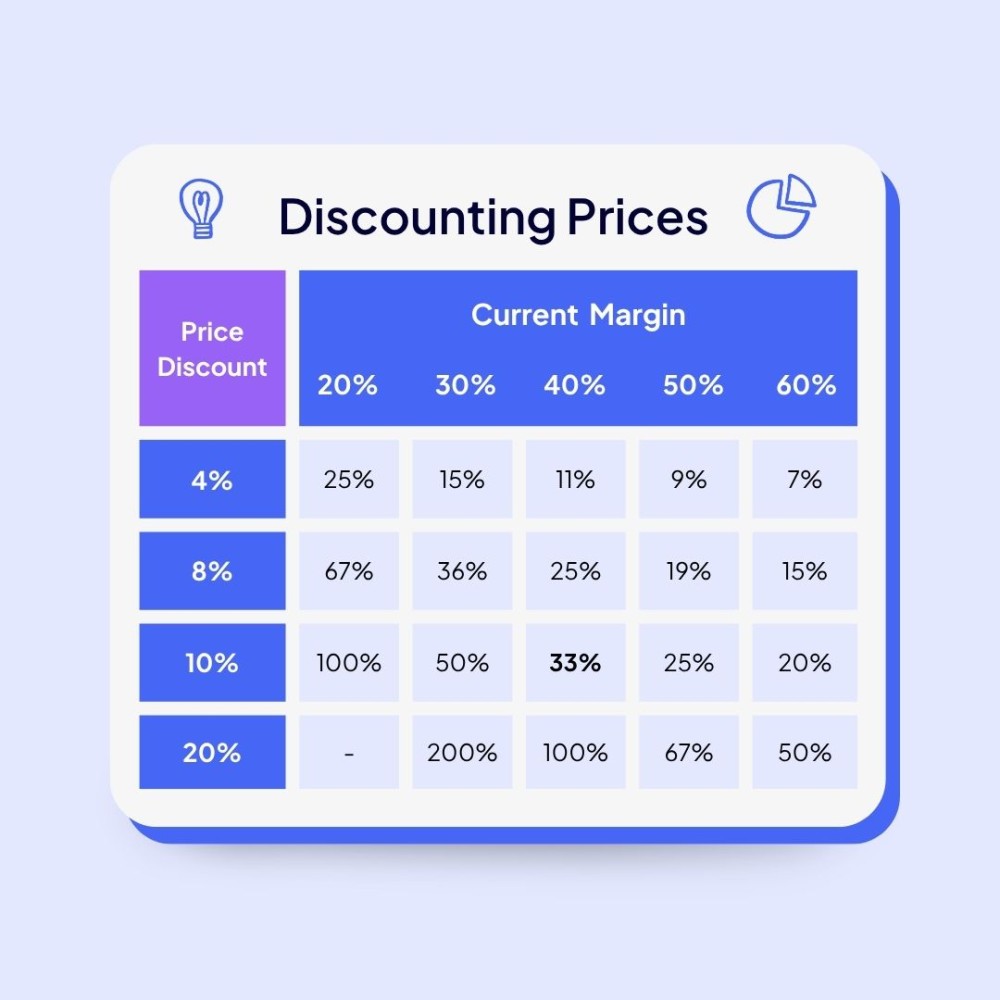
This is the table most people wish they'd seen earlier; it's certainly memorable and something I refer back to with clients.
If your margin sits at 40% and you discount by 10%, you don't just lose 10%. You need your sales volume to increase by 33% just to end up where you started.
Read that again. A third more sales just to stand still. But it doesn’t mean you should never discount; you just have to understand the impact if you do, including the impact on special offers, client acquisition costs, etc.
You know how we all get mad that internet providers offer a discount to new members but not to existing ones? Well, that’s because of the cost of acquisition of a client - they are willing to lose out on those two years, as they know they’ll make it up in the long run.
If you are a service-based business, where you are selling time, you need to be mindful - as you are discounting your time.
At a 20% margin, a 10% discount means you'd need to double your volume. Your entire workload (doubled) to make up for a discount you probably offered because a client pushed back, or because it felt like the right thing to do in the moment.
That's the bit that doesn't get said out loud enough in business. Discounting isn't free. It never has been. It just feels free in the moment, because you've still made a sale.

This is the table people are afraid to look at, because looking at it makes them want to put their prices up, and that feels terrifying.
But here's what it actually shows: at a 40% margin, a 10% price increase means your sales could drop by 20%, and you'd still be making the same gross profit. This is what I want you to really take away from this graph: believe in yourself, know your value and don’t be afraid to increase your prices.
Fewer clients. Less work. Same money.
That's not a threat. That's an opportunity.
Usually one of three things.
They're worried clients will leave. Some will. But as the table shows, you can afford to lose more than you think, and you'll almost certainly lose fewer than you fear.
They don't know how to have the conversation. Pricing is personal. Especially when you've built relationships. Telling a client your rates are going up can feel like a rejection. It isn't. It's business. And most clients, especially the good ones, will understand.
They haven't looked at the numbers. This one's the most fixable and the most common. When you can see what a price increase actually does to your margin (when it's sitting right there in a table) it changes the conversation you have with yourself.
Not just check it. Not just think "yeah, roughly right." Actually sit down and ask whether your prices still reflect what it costs you to deliver, what the market will bear, and what you're genuinely worth.
If it was more than twelve months ago, you've probably already left money on the table. Costs go up. Inflation doesn't wait. Suppliers don't apologise for it. You shouldn't either.
A price increase doesn't have to be dramatic. A 4% or 5% increase feels small. But look at that table again, at a 40% margin, a 4% increase means sales could fall by 9% before your profit takes a hit.
For most businesses, that's a very comfortable buffer.
1. When did you last review your prices properly?
2. Do you know the real cost of the discounts you give, in numbers rather than gut feel?
3. Is there a service, a client, or a rate that you know needs revisiting but you've been putting off?
If the answer to any of those makes you slightly uncomfortable, you know what to do with that.










.png)
.png)